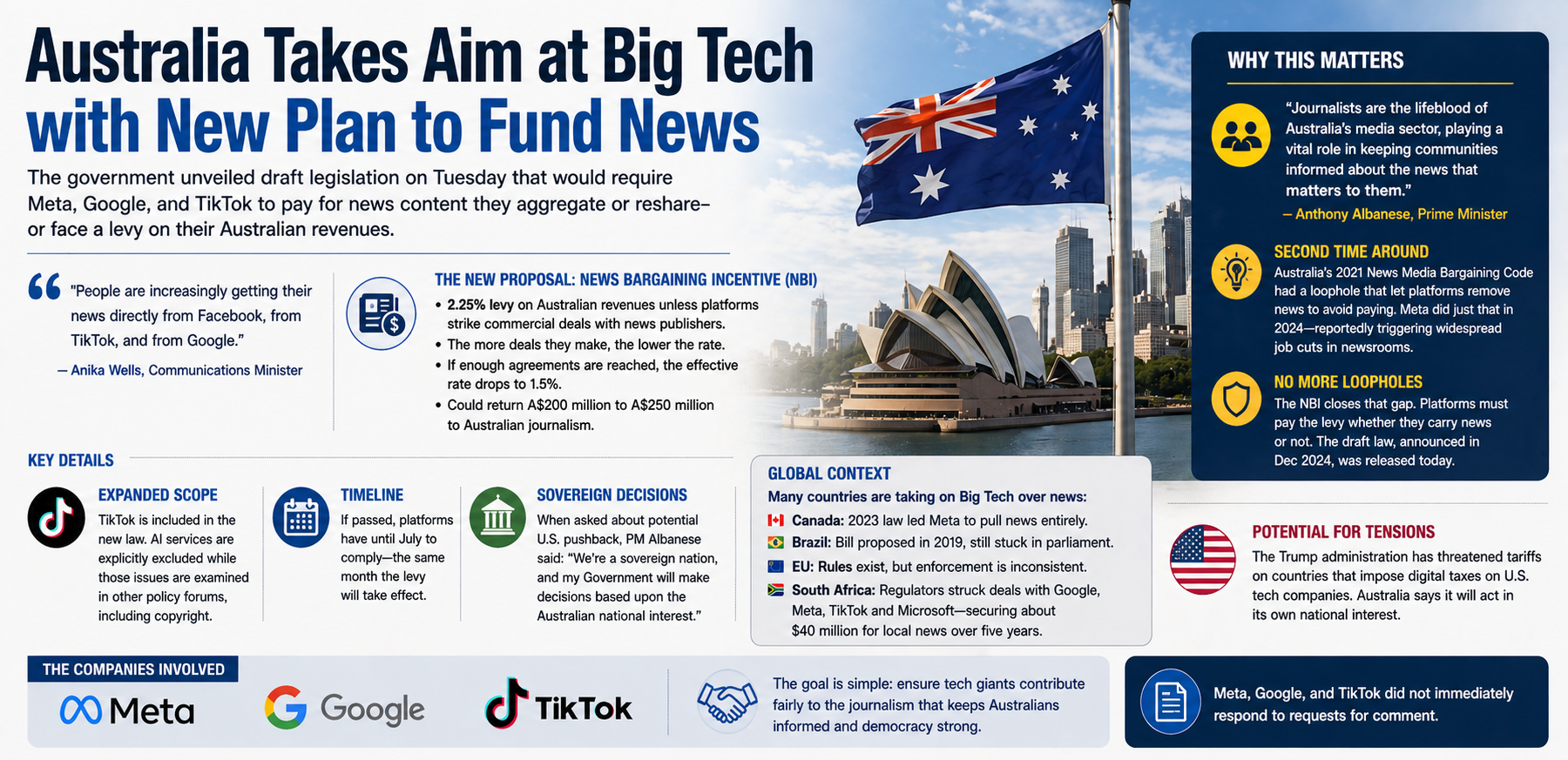
Communications Minister Anika Wells noted that many people now consume news directly through platforms like Facebook, TikTok, and Google, highlighting the growing influence of these companies in the media landscape.
The proposed policy, known as the News Bargaining Incentive (NBI), would apply a 2.25% charge on the local revenue of these tech firms unless they negotiate payment agreements with Australian news publishers. The more deals they secure, the lower the rate becomes—potentially dropping to 1.5%. This system could return between A$200 million and A$250 million to support journalism in the country.
Prime Minister Anthony Albanese emphasized the importance of journalists, describing them as essential to keeping the public informed and maintaining a healthy media ecosystem.
This marks Australia’s second effort to require Big Tech to fund news. The earlier News Media Bargaining Code, introduced in 2021, aimed to do the same but allowed companies to sidestep payments by removing news content altogether. Meta took that route in 2024, which reportedly led to significant job losses across Australian media outlets.
The new proposal seeks to close that loophole. Under the NBI, companies would still face the levy even if they choose not to host news content. Initially announced in late 2024, the draft legislation is now being formally presented.
Notably, TikTok is included in this updated approach, expanding beyond the original framework. However, AI-related services are excluded for now, as officials say those issues are being addressed separately through ongoing policy discussions, including copyright considerations.
The move could also create international tension. The Trump administration has strongly opposed digital taxes targeting U.S. tech companies and has threatened tariffs against countries implementing such measures. When asked about potential backlash, Albanese stated that Australia would act based on its own national interests.
If the law is approved, companies will need to comply by July, when the levy is set to take effect.
Australia is part of a broader global effort to regulate Big Tech’s role in news distribution. Countries like Canada, Brazil, and members of the European Union have attempted similar measures, with varying outcomes. Canada’s law led Meta to remove news entirely, Brazil’s proposal has stalled, and EU enforcement has been inconsistent. South Africa, however, has seen some success, securing agreements with major platforms that will provide around $40 million to local media over five years.
As of now, Meta, Google, and TikTok have not publicly responded to the proposed Australian legislation.