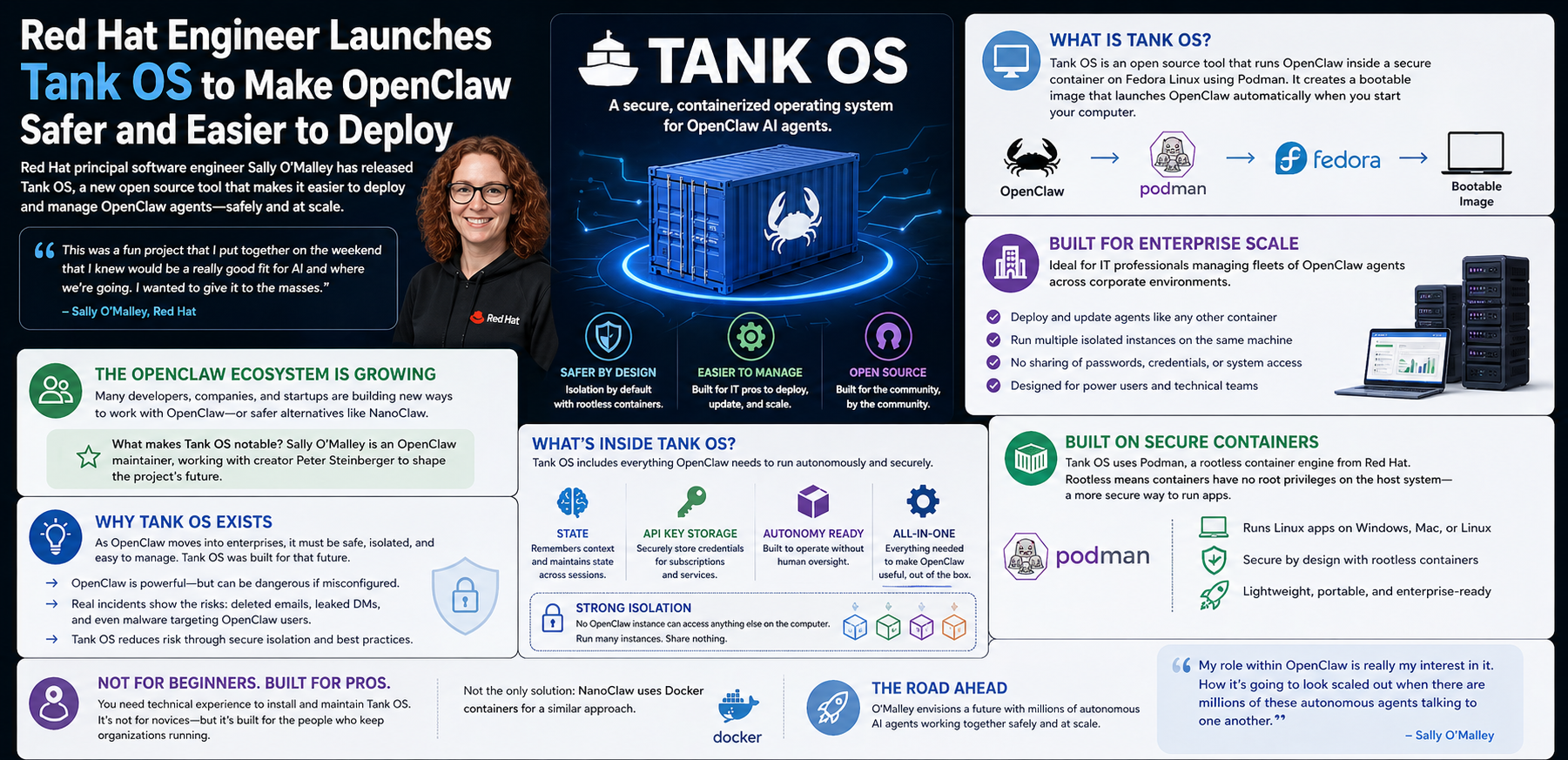
Red Hat principal software engineer Sally O’Malley has introduced a new open source tool called Tank OS, designed to simplify and secure the deployment of OpenClaw AI agents. Built as a weekend project, the tool aims to make advanced AI capabilities more accessible while improving safety and manageability.
Built for Power Users and IT Professionals
Tank OS is tailored for experienced users running OpenClaw locally, as well as IT teams responsible for managing large numbers of AI agents across enterprise environments. It focuses on making deployments safer and easier to maintain at scale.
Growing Ecosystem Around OpenClaw
OpenClaw, an open source project that installs AI agents on local machines, has sparked widespread innovation. Numerous developers and startups are building tools and alternatives, including competitors like NanoClaw, which emphasize enhanced safety features.
Backed by an OpenClaw Maintainer
O’Malley’s involvement stands out because she is an official maintainer of OpenClaw. She works closely with project leader Peter Steinberger to shape its development, particularly for enterprise use and compatibility with Red Hat’s Linux systems.
Designed for Enterprise-Scale AI Adoption
Motivated by the future of AI in large organizations, O’Malley created Tank OS to address the challenges of deploying OpenClaw in enterprise settings. Her goal is to support scalable, secure, and open AI usage.
Powered by Secure Container Technology
Tank OS is built using Podman, a container tool developed by Red Hat. Containers package applications with everything they need to run, and Podman’s “rootless” design enhances security by limiting system-level access.
Bootable and Self-Contained AI Environment
The system runs OpenClaw داخل a Fedora Linux environment within a Podman container. It creates a bootable image that automatically launches OpenClaw when the computer starts, making deployment seamless.
Key Features for Autonomous Operation
Tank OS includes essential components for independent AI operation, such as memory (state), secure API key storage, and other tools that allow OpenClaw agents to function without constant human input.
Isolation and Multi-Instance Support
Users can run multiple Tank OS instances on a single machine, each isolated from the others. This prevents shared access to sensitive data like passwords and ensures that one agent cannot interfere with another or the host system.
Addressing Security Risks
Despite its capabilities, OpenClaw can pose risks if misconfigured. There have been reports of AI agents deleting emails or exposing private data. Tank OS aims to mitigate these risks through stronger isolation and controlled environments.
Not Designed for Beginners
While Tank OS improves safety, it still requires technical expertise to install and manage. It is not intended for casual users but rather for those comfortable working with advanced software systems.
Competing Container-Based Solutions
Tank OS is not alone in using containerization for AI agents. Projects like NanoClaw also leverage similar approaches, such as Docker, to provide secure and portable environments.
Future of Scalable AI Agents
O’Malley envisions a future where millions of autonomous AI agents operate across organizations. Tank OS is a step toward managing that scale, giving IT teams tools to deploy, update, and control AI systems efficiently.