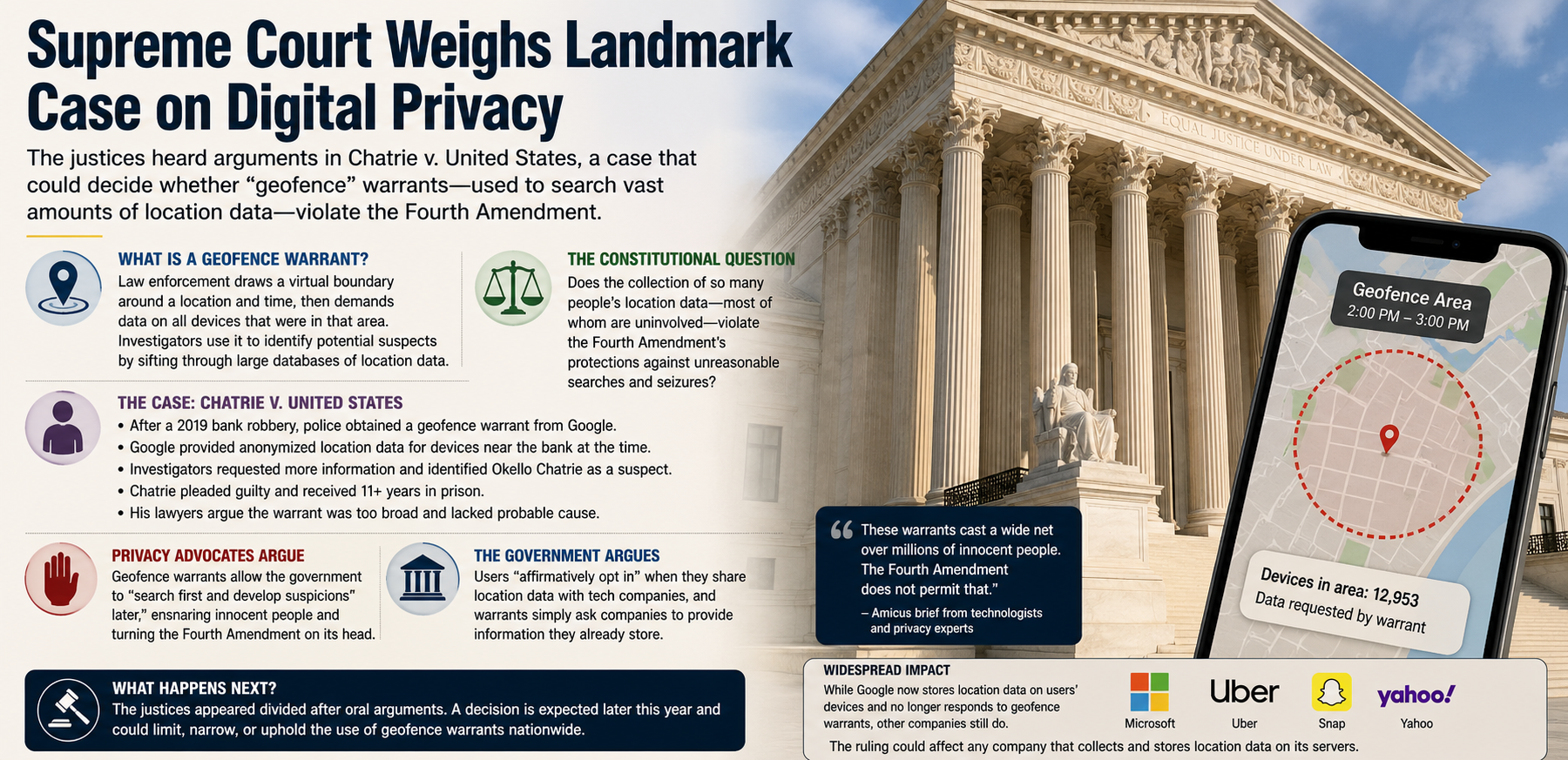
At the center of the case, Chatrie v. United States, is the government’s use of “geofence” warrants. These orders allow law enforcement to require tech companies—such as Google—to provide data identifying which users were present in a specific location during a certain time period, based on their devices’ location history.
By sweeping through massive databases of location information, investigators can work backward to identify potential suspects, essentially narrowing down who might have been at a crime scene. Critics, however, argue that this approach is overly broad and unconstitutional because it also captures data from individuals who have no connection to the crime. In some instances, innocent people have been caught up in investigations simply for being nearby, and such warrants have even been used to identify people attending protests or other lawful gatherings.
Geofence warrants have become increasingly common since their first reported use in 2016. Since 2018, thousands have been issued annually by federal and local authorities, making up a significant share of the data requests received by companies like Google, which collect location information through services such as Maps, search activity, and Android devices.
This case represents the Supreme Court’s first major Fourth Amendment review of the decade and could determine whether these warrants are permissible. A central question is whether individuals have a “reasonable expectation” of privacy over location data held by tech companies.
The case stems from a 2019 bank robbery in Virginia involving Okello Chatrie. Investigators, after reviewing surveillance footage showing a suspect using a cellphone, obtained a geofence warrant requesting data on all devices within a defined radius of the bank during a set timeframe. Google initially provided anonymized data, after which authorities requested additional details on certain accounts. Eventually, three individuals were identified, including Chatrie.
Chatrie later pleaded guilty and was sentenced to more than 11 years in prison. However, his attorneys argue that the evidence obtained through the geofence warrant should not have been admissible. They claim the warrant violated constitutional protections by allowing authorities to search broadly without first establishing probable cause tied to a specific individual.
A lower court acknowledged that the warrant lacked sufficient specificity but allowed the evidence anyway, citing that law enforcement acted in “good faith.” Privacy advocates maintain that such warrants effectively reverse traditional legal standards by enabling authorities to search first and identify suspects afterward.
An amicus brief from technologists and security experts further argued that the warrant required Google to comb through vast amounts of user data, which they say conflicts with Fourth Amendment protections.
The government, on the other hand, argues that Chatrie consented to the collection and storage of his location data by using Google services, and that the warrant simply required the company to provide relevant information. Officials have also suggested that rejecting such warrants entirely would hinder law enforcement capabilities.
After a divided ruling in lower courts, the Supreme Court agreed to review the case. Early reactions from Monday’s arguments suggest the justices are split. Some analysts believe the court may allow geofence warrants to continue but impose stricter limits on how they are used, rather than banning them outright.
Although the case centers on Google, its outcome could affect many companies that store user location data. In response to privacy concerns, Google has already shifted to storing such data directly on users’ devices and has stopped complying with geofence warrants. Other companies, including Microsoft, Uber, Snap, and Yahoo, have previously received similar requests and could be impacted by the court’s decision.